Thread Painting for Beginners: Realistic Embroidery Explained
What thread painting is and how to start: choosing shades, stitch direction, long and short stitch blending, and a simple first petal project.
By Ayoub Farid · · 2 min read
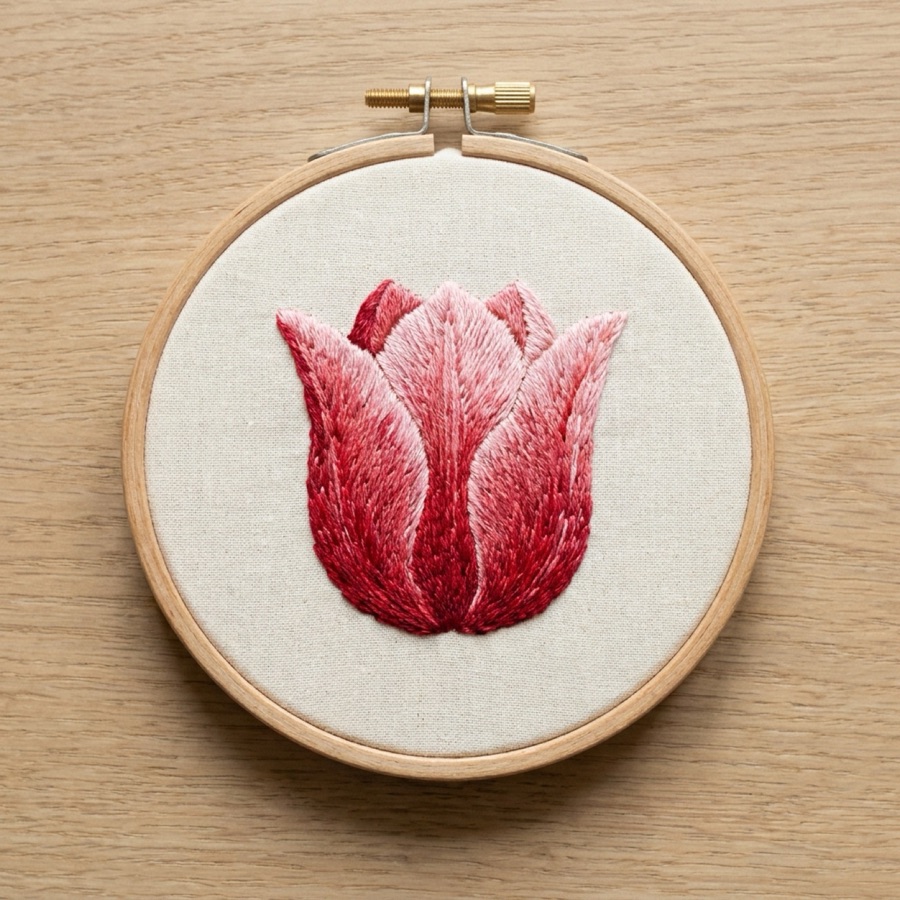
Thread painting (also called needle painting or silk shading) uses many shades of thread and fine stitches to create realistic, painterly embroidery: lifelike flowers, birds, pets. It looks advanced, but it's built on one stitch, long and short stitch, plus a few principles.
Before you start
You should be comfortable with split stitch, satin stitch and basic tension. If not, start with our 4-week plan.
The key principles
1. Use one strand
Single strands blend smoothly. Two strands are fine for a bolder style.
2. Choose close shades
Pick 4–6 shades of one colour that step gradually from dark to light. Big jumps in shade create visible stripes.
3. Follow the direction of growth
Stitches should follow the way a petal, leaf or feather grows. Draw direction lines on your fabric before you start.
4. Blend by stitching into previous stitches
Each new row comes up through the ends of the previous row's stitches. This hides the join.
5. Vary stitch lengths
Uneven row edges blend; even rows make stripes.
A first project: one petal
- Draw a single petal about 3 cm long and add direction lines fanning from the base to the tip.
- Outline the outer edge with split stitch in the lightest shade.
- Row 1 (outer edge): long and short stitches over the outline, lightest shade.
- Row 2: next shade, coming up through row 1.
- Row 3–4: darker shades toward the base.
- Step back and look from a distance. Add single stitches to soften any harsh lines.
Common beginner problems
| Problem | Fix |
|---|---|
| Visible stripes | Vary lengths; use closer shades |
| Fabric showing | Add more stitches; keep them close |
| Chaotic direction | Draw guide lines first |
| Bulky and raised | Use 1 strand |
Choosing a reference
Work from a clear photo. Look for where light hits (lightest shade) and where shadows fall (darkest). Squint to simplify the shapes.
Thread painting rewards patience. Practise single petals and leaves first, then combine them, before attempting a full flower or animal.
Frequently asked questions
What is thread painting?
A style of embroidery that blends many thread shades with fine long and short stitches to create realistic images.
Is thread painting hard for beginners?
It needs patience and good basics, but the stitch itself is simple. Start with one petal.
How many strands for thread painting?
Usually one strand for the smoothest blend.
How many colours do I need?
Four to six close shades of each main colour.