Why Do My Embroidery Stitches Look Uneven? (And How to Fix It)
Fix uneven hand embroidery stitches: different stitch lengths, wobbly lines and inconsistent thickness. Practical drills to make every stitch the same.
By Ayoub Farid · · 2 min read
Uneven stitches are the most common thing that makes beginner embroidery look "homemade" in the wrong way. The good news is that unevenness has specific causes, and specific drills fix it faster than just stitching more.
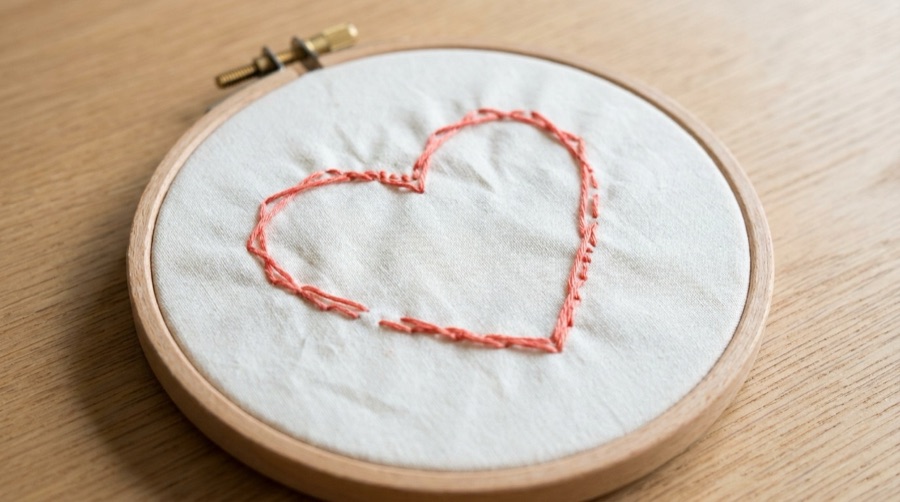
Three kinds of uneven
1. Different stitch lengths
Some stitches long, some short. Most visible in running stitch and back stitch.
Why: you're judging each stitch separately instead of keeping a rhythm.
Fixes:
- Mark dots every 3 mm along the line for your first few rows. Then try by eye.
- Use a reference stitch: measure each new stitch against the previous one.
- Find a rhythm: "down... up... down... up" at a steady pace.
2. Wobbly lines
The line drifts off the drawn guide.
Why: looking at the needle instead of the line; loose fabric; rushing.
Fixes:
- Look at where the needle will come up, on the line, before every stitch.
- Re-tighten the hoop.
- Turn the hoop so you're always stitching in your comfortable direction.
3. Uneven thickness
Some stitches look thinner or fatter.
Why: different tension, or strands twisted in some stitches and flat in others.
Fixes:
- Pull every stitch until it just lies flat (thread tension).
- Untwist the thread by letting the needle dangle.
- Strip and recombine strands before threading.
Drills that work
- Ten rows of ten. Stitch ten rows of ten running stitches. Compare the first and last row.
- Same line, three lengths. One row long (5 mm), one medium (3 mm), one short (2 mm). Teaches control.
- Re-stitch, don't move on. Stitch a heart. Find the worst part. Stitch the heart again, focusing only on that part.
Curves are a special case
Stitches that are fine on straight lines look angular on curves. Shorten them on curves: about half the length. See how to embroider smooth curves and stitch length guide.
Get an outside view
It's hard to see your own unevenness while stitching up close. Look at your work from arm's length or in a photo. Hoopie's photo coach checks this specifically: "uneven" is one of the named problems, and the fix tells you where ("the stitches on the left curve are longer than the rest").
Frequently asked questions
How do I make my embroidery stitches even?
Keep a steady rhythm, mark dots for your first lines, pull each stitch with the same tension, and keep the fabric drum-tight.
Why are my stitches different sizes?
You're judging each stitch separately. Use the previous stitch as a reference and keep a rhythm.
How long should embroidery stitches be?
Around 3 mm is a good default; shorter on curves. See the stitch length guide.
Does it matter if my stitches are uneven?
For learning, it's normal. Consistency comes with practice and makes designs look much cleaner.