Embroidery for Beginners: How to Learn Hand Embroidery
A complete beginner's path to hand embroidery: supplies, your first stitches in order, a first project, and how to practise so you improve fast.
By Ayoub Farid · · 3 min read
Hand embroidery is one of the easiest crafts to start: a hoop, some fabric, thread and a needle cost very little, and you can stitch something pretty on your first evening. Getting neat, though, is where most beginners stall. This guide gives you a clear path from zero to your first finished hoop, and explains how to practise so your stitches actually improve.
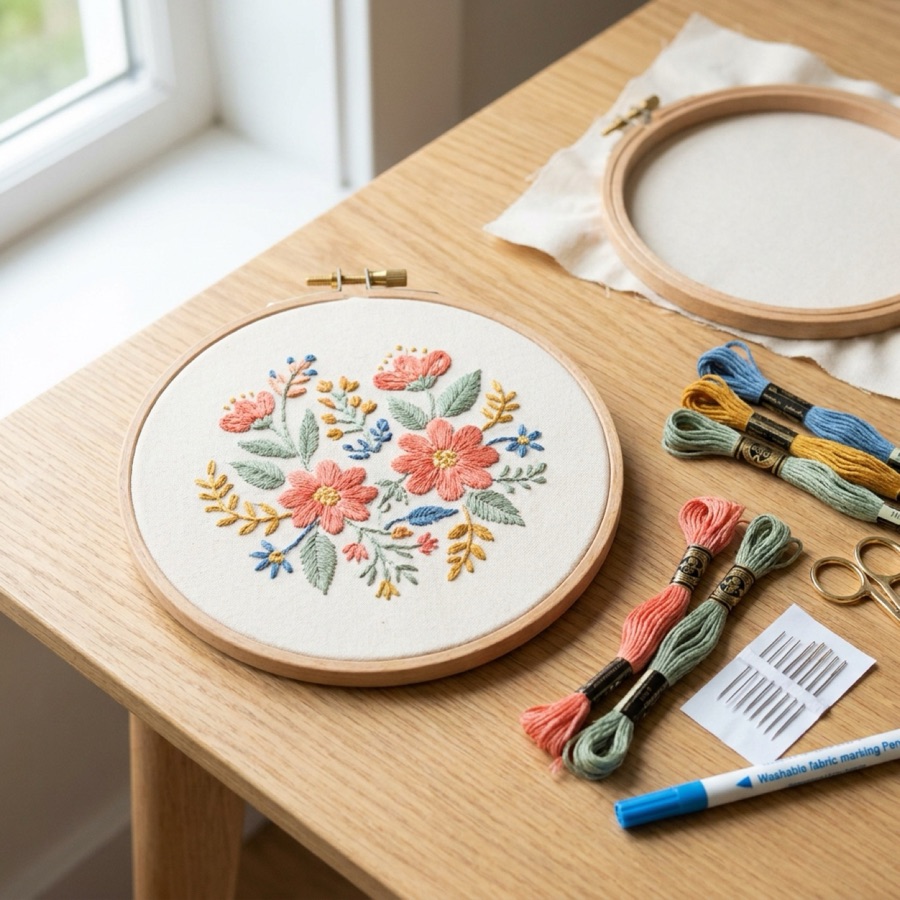
Step 1: Get the basic supplies
You need only six things:
- An embroidery hoop, 15–20 cm (6–8 in). Wooden or plastic both work.
- Plain woven cotton or linen fabric, medium weight. Avoid stretchy fabrics to start.
- Six-strand embroidery floss in a few colours.
- Embroidery needles (also called crewel needles), size 5–9.
- Small sharp scissors.
- A washable fabric pen or pencil to draw your design.
Full details and what to skip in embroidery supplies for beginners.
Step 2: Set up your hoop
Loosen the screw, lay the fabric over the inner ring, press the outer ring on and tighten. Tug the edges until the fabric is tight like a drum: when you tap it, it should make a little sound. Keep the screw at the top so your thread doesn't catch on it. See how to use an embroidery hoop.
Step 3: Prepare your thread
Cut a length about as long as your forearm (40–45 cm). Separate the number of strands you need (usually 2 or 3) from the six, then put them back together. Thread the needle and tie a small knot or use a waste knot. More in how to thread an embroidery needle and how to start and end embroidery thread.
Step 4: Learn the stitches in order
Learn line stitches first, because they teach control:
- Week 1: Running stitch and back stitch. Straight lines, then a heart.
- Week 2: Stem stitch and split stitch. Curves and letters.
- Week 3: French knots and satin stitch. Dots and fills.
- Week 4: Lazy daisy and a first flower hoop.
That's the same sequence as Hoopie's 4-week embroidery plan. For the bigger picture, see 28 hand embroidery stitches.
Step 5: Stitch a first project
Choose something small with only two or three stitches: a heart outline, a single flower, a word. Our easy embroidery patterns for beginners list has ideas that use only the first-week stitches.
Step 6: Practise with feedback
Here is the part most guides skip. Watching tutorials teaches you how a stitch works; it doesn't tell you what's wrong with your stitches. Beginners often can't see that their stitches are getting longer on curves, or that the fabric is slowly loosening in the hoop.
Three ways to get feedback:
- Compare against a reference photo, side by side, at the same scale.
- Look at your work from arm's length, then up close. Unevenness jumps out from a distance.
- Use a coach. In Hoopie, you snap a photo of your hoop after each step and get a score, what's working, and up to two specific fixes ("the stitches on the left curve are longer than the rest"). See how AI embroidery feedback works.
Step 7: Practise little and often
Ten to fifteen minutes a day beats a three-hour session once a week. Short, regular practice builds the muscle memory that makes stitches consistent. Hoopie's daily streak and reminders are built around this.
Common beginner mistakes
- Fabric too loose in the hoop → puckering and wobbly lines
- Thread too long → tangles and knots
- Pulling stitches too tight → puckers and thin lines
- Long stitches on curves → angular shapes
All of these are covered in common embroidery mistakes and how to fix them.
Frequently asked questions
Is hand embroidery easy to learn?
The basics are easy: you can stitch a simple design on your first day. Neat, consistent stitches take a few weeks of short, regular practice. See is embroidery hard to learn?
What should a beginner embroider first?
A straight line of running stitch, then a back stitch heart. Then a small design using two or three stitches.
How long does it take to learn embroidery?
Most people are comfortable with the basic stitches in two to four weeks of 10–15 minutes a day. More in how long does it take to learn embroidery.
Can I teach myself embroidery?
Yes. Most embroiderers are self-taught with books, videos and apps. Getting feedback on your own stitches speeds it up a lot.